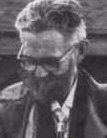
W. Ross Ashby        zurück ]      [ Index ]      [ Literatur-Index ]      [ Die Hyper-Bibliothek ]     

Literatur

Einführung in die Kybernetik
Design for a Brain

zur Person


W. Ashby hat 1956 eine die Kybernetik konsolidierende Einführung publiziert. Er war Teilnehmer der Macy-Konferenz, er sprach dort ca 1951 über Intelligence Amplifiers: Ein Schachmaschine, die den Menschen beim Schach schlägt, der sie erfunden hat (laut Heinz von Foerster:232f.
Heinz von Foerster holte ihn an das BioLab (Universität Illinois).

Zitate

"Tatsächlich könnte man Kybernetik definieren als Erforschung von Systemen, die offen für Energie, aber geschlossen für Information, Regelung und Steuerung sind, - von Systemen, die 'informationsdicht' sind" (19). (Cybernetics might, in fact, be defined as the study of systems that are open to energy but closed to information and control — systems that are “information-tight” (S. 9/19).

das spukende Haus als ideeller Mechanismus

Begriffe

Gedächtnis


Arbeitsspeicher:

Schau dir an, was passiert, nicht, warum es passiert; sammle niemals mehr Informationen als du für die gegenwärtig gestellte Aufgabe brauchst; und nimm nicht an, dass sich das System nicht ändert, das heißt stelle in Rechnung, dass du nur die Probleme lösen kannst, die sich heute stellen, sind die drei Regeln, die W. Ross Ashby (1958, 97 f.) als Essenz seiner Version des "operational research" beschreibt.

Ashby, W. Ross (1958): Requisite Variety and Its Implications for the Control of Complex Systems, in: Cybernetica 1, S. 83-99. Ashby, W. Ross (1961): Principles of Self-Organization. In: Heinz von Foerster, G. W. Zopf, jr. (Hrsg.), Principles of Self-Organization. New York: Pergamon, S. 255-278.

aus Baecker Management


William Ross Ashby (* 6. September 1903 in London, England; † 15. November 1972) war ein britischer Psychiater und Pionier in dem Studium komplexer Systeme. Obwohl sehr einflussreich in der Kybernetik, Systemtheorie und komplexer Systeme ist er nicht so bekannt wie Herbert Simon, Norbert Wiener, Ludwig von Bertalanffy und Stuart Kauffman. Von 1947 bis 1959 war Ashby Forschungsdirektor am Barnwood House Hospital in Gloucester. Von 1959 bis 1960 war er Direktor des Burden Neurological Institute und von 1960 bis 1970 des Department of Electrical Engineering an der University of Illinois in Urbana. Werke [Bearbeiten]Principles of the Self-Organizing Dynamic System, Journal of General Psychology 37 (1947) 125-128 (erste gedruckte Erwähnung des Begriffs "self-organizing"). The applications of cybernetics to psychiatry, Journal of Mental Science 100 (1954) 114-124 Design for an intelligence amplifier, Automata studies, Princeton 1956 The effect of experience on a determinate dynamic system, Behavioral Science 1 (1956) 35-42 Design for a Brain, Chapman & Hall, 2nd edition, 1966, ISBN 0-412-20090-2 (Originalausgabe, 1952) Introduction to Cybernetics, Chapman & Hall, 1956, ISBN 0416683002 (auch als PDF elektronisch verfügbar in der Principia Cybernetica (http://pespmc1.vub.ac.be/ASHBBOOK.html)); Dt.: Einführung in die Kybernetik. Frankfurt a.M.: Suhrkamp, 1974; 2. Aufl. 1985 (Suhrkamp Taschenbuch Wissenschaft ; 34) ISBN 3-518-27634-4 Principles of Self-Organizing Systems in Heinz von Foerster and George W. Zopf, Jr. (eds.), Principles of Self-Organization (Sponsored by Information Systems Branch, U.S. Office of Naval Research), 1962


The Law of Requisite Variety The larger the variety of actions available to a control system, the larger the variety of perturbations it is able to compensate. -------------------------------------------------------------------------------- Control or regulation is most fundamentally formulated as a reduction of variety: perturbations with high variety affect the system's internal state, which should be kept as close as possible to the goal state, and therefore exhibit a low variety. So in a sense control prevents the transmission of variety from environment to system. This is the opposite of information transmission, where the purpose is to maximally conserve variety. In active (feedforward and/or feedback) regulation, each disturbance D will have to be compensated by an appropriate counteraction from the regulator R. If R would react in the same way to two different disturbances, then the result would be two different values for the essential variables, and thus imperfect regulation. This means that if we wish to completely block the effect of D, the regulator must be able to produce at least as many counteractions as there are disturbances in D. Therefore, the variety of R must be at least as great as the variety of D. If we moreover take into account the constant reduction of variety K due to buffering, the principle can be stated more precisely as: V(E) ³ V(D) - V(R) - K Ashby has called this principle the law of requisite variety: in active regulation only variety can destroy variety. It leads to the somewhat counterintuitive observation that the regulator must have a sufficiently large variety of actions in order to ensure a sufficiently small variety of outcomes in the essential variables E. This principle has important implications for practical situations: since the variety of perturbations a system can potentially be confronted with is unlimited, we should always try maximize its internal variety (or diversity), so as to be optimally prepared for any foreseeable or unforeseeable contigency. Some Comments Ashby's Law can be seen as an application of the principle of selective variety. However, a frequently cited stronger formulation of Ashby's Law, "the variety in the control system must be equal to or larger than the variety of the perturbations in order to achieve control", which ignores the constant factor K, does not hold in general. Indeed, the underlying "only variety can destroy variety" assumption is in contradiction with the principle of asymmetric transitions which implies that spontaneous decrease of variety is possible (which is precisely what buffering does). For example, a bacterium searching for food and avoiding poisons has a minimal variety of only two actions: increase or decrease the rate of random movements. Yet, it is capable to cope with a quite complex environment, with many different types of perturbations and opportunities. Its blind "transitions" are normally sufficient to find a favourable situation, thus escaping all dangers. Ashby's law is perhaps the most famous (and some would say the only successful) principle of cybernetics recognized by the whole Cybernetics and Systems Science community. The Law has many forms, but it is very simple and common sensical: a model system or controller can only model or control something to the extent that it has sufficient internal variety to represent it. For example, in order to make a choice between two alternatives, the controller must be able to represent at least two possibilities, and thus one distinction. From an alternative perspective, the quantity of variety that the model system or controller possesses provides an upper bound for the quantity of variety that can be controlled or modeled. Requisite Variety has had a number of uses over the years , and there are a number of alternative formulations. Variety can be quantified according to different distributions, for example probabilistic entropies and possibilistic nonspecificities. Under a stochastic formulation, there is a particularly interesting isomorphism between the LRV, the 2nd Law of Thermodynamics, and Shannon's 10th Theorem . http://pespmc1.vub.ac.be/ASHBBOOK.html Ashby's book "Introduction to Cybernetics" W. Ross Ashby (1956): An Introduction to Cybernetics, (Chapman & Hall, London): now available electronically. -------------------------------------------------------------------------------- Principia Cybernetica has selected Ashby's "Introduction to Cybernetics" as a classic book that deserved to be published again electronically. The original version has been out of print for many years. A few copies may still be found in libraries or ordered through the Amazon bookshop. However, we believe that the book is so important that it should reach as an wide audience as possible. The best medium to achieve that seemed to be the world-wide web. This publication has been made possible largely through Mick Ashby, the author's grandson, who has convinced the copyright holders (the Ashby estate) that they should allow us to produce an electronic version. W. Ross Ashby is one of the founding fathers of both cybernetics and systems theory. He developed such fundamental ideas as the homeostat, the law of requisite variety, the principle of self-organization, and the principle of regulatory models. Many of these insights were already proposed in the 1940's and 1950's, long before the presently propular "complex adaptive systems" approach arrived at very similar conclusions. Whereas the concepts surrounding the complexity movement are often complicated and confuse, Ashby's ideas are surprisingly clear and simple, yet deep and universal. This elegance of thought is illustrated in particular by the present book, which is still the only real textbook on cybernetics (and, one might add, system theory). It explains the basic principles with concrete examples, elementary mathematics and exercises for the reader. It does not require any mathematics beyond the basic high school level. Although simple, the book formulates principles at a high level of abstraction. For more concrete and extensive illustrations of systems principles, you may refer to our other electronic books, "The Macroscope" and "The Phenomenon of Science". For a similar abstract, high-level, but technically simple approach, this time to physics, you can check "Representation and Change". The electronic version of Ashby's book has been formatted as a PDF file (1.9 Mb), with two pages of the original book per printed A4 page. This format, although it can be read on-screen, is basically meant for printing out. The print-out will be similar to the original book, including the original figures, formulas, answers to exercises, table of contents and index. You can read or print it with the free PDF reader from Adobe. Table of Contents 1: WHAT IS NEW The peculiarities of cybernetics The uses of cybernetics PART ONE: MECHANISM 2: CHANGE Transformation Repeated change 3: THE DETERMINATE MACHINE Vectors 4: THE MACHINE WITH INPUT Coupling systems Feedback Independence within a whole The very large system 5: STABILITY Disturbance Equilibrium in part and whole 6: THE BLACK BOX Isomorphic machines Homomorphic machines The very large Box The incompletely observable Box PART TWO: VARIETY 7: QUANTITY OF VARIETY Constraint Importance of constraint Variety in machines Transmission from system to system Transmission through a channel 9: INCESSANT TRANSMISSION The Markov chain Entropy Noise PART THREE: REGULATION AND CONTROL 10: REGULATION IN BIOLOGICAL SYSTEMS Survival 11: REQUISITE VARIETY The law Control Some variations 12: THE ERROR-CONTROLLED REGULATOR The Markovian machine Markovian regulation Determinate regulation The power amplifier Games and strategies 13: REGULATING THE VERY LARGE SYSTEM Repetitive disturbance Designing the regulator Quantity of selection Selection and machinery 14: AMPLIFYING REGULATION What is an amplifier? Amplification in the brain Amplifying intelligence REFERENCES ANSWERS TO EXERCISES INDEX