|
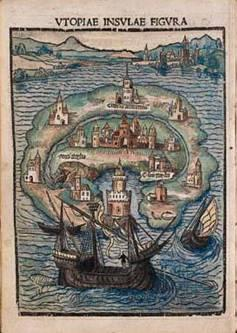
Als Utopie bezeichne ich die Beschreibung einer anzustrebenden Welt. Die Utopie ist mihin kein Wunsch(traum) und nichts Unmögliches oder Unwahrscheinliches, sondern eine Anleitung zur Gestaltung gesellschaftlicher Verhältnisse, wobei insbesondere auch, welche Verhältnisse als gesellschaftliche betrachtet werden und wie diese erreicht werden können. Differenztheoretisch ist die Utopie die Differenz zwischen Verhältnissen und wie diese Verhältnisse besser sein könnten. Differenziel beschreibt jede Utopie, wie es jetzt gerade ist. Der Ausdruck Utopie stammt aus dem Titel Utopia des 1516 erschienenen Romans Utopia von Thomas Morus, der darin seine ideale Gesellschaft beschreibt. Utopia liegt nicht in der Zukunft, sondern in einer fernen Gegend, das heisst, seine Utopie ist real. Utopia wird allerdings oft als Satire aufgefasst. Gegensatzpaare:Utopie/Dystopie
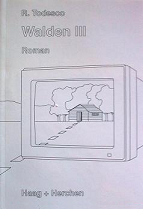
Die Utopie beschreibt immer subjektiv bessere Verhältnisse (etwa: Thomas Morus' Utopia, B. Skinner: Walden two, oder R. Todesco: Walden III, es gibt aber auch die Dystopien, sozusagen eine Negativ-Utopie, in welcher schlechte Welten beschrieben werden, die wir meiden sollten (etwa: George Orwell: 1984 oder Animal Farm oder Aldous Huxley: Brave New World). Die Utopie beschreibt nicht die Zukunft, sondern eine denkbare Möglichkeit. Auch dazu gibt es eine Alternative, Science Fiction beschreibt, was jetzt noch nicht denkbar ist, sondern erst noch denkbar werden könnte, wobei auch Scinece Fiction nicht an die Zukunft, sondern an andere Technologien gebunden ist. Die Utopie beschreibt einen Uebergangsprozess, während die Fantasie einen Zustand beschreibt, ohne sich um die Realisierung zu kümmern (vgl dazu (etwa: konkrete Utopie von E. Bloch). Die Satire kann als Utopie auftreten, indem sie eine bessere Welt beschreibt, die niemand möchte (etwa das Schlaraffenland). Und natürlich kann man jede Utopie als Satire abewehren, was schon seit Utopia gemacht wird. Utopische LiteraturDie als klassisch zu bezeichnenden Vorläufer der modernen utopischen Literatur sind neben Thomas Morus' Utopia (1516), >Tommaso Campanella "Der Sonnenstaat" (1623), Christianopolis(1619) von Johann Valentin Andreae und Francis Bacons Neu-Atlantis (1626). Die Utopie verwendet als Erzählmodus sehr oft eine "Insel", die als autopietische Zelle fungiert. Utopia und Atlantis waren as eigentliche Inseln gedacht, Walden two und Walden III sind quasi ökonomische Inseln. (Beispiele: Johann Gottfried Schnabels: Insel Felsenburg
|
I
|
Mehr Beispiele von Utopien
www.tagederutopie.org
ebooks.adelaide.edu.au/themes/topian.html
Utopian and Dystopian Fiction
The utopia and its offshoot, the dystopia, are genres of literature that explore social and political structures. Utopian fiction is the creation of an ideal world, or utopia, as the setting for a novel. Dystopian fiction is the opposite: creation of a nightmare world, or dystopia. Many novels combine both, often as a metaphor for the different directions humanity can take in its choices, ending up with one of two possible futures.
Works
Utopia / Thomas More [1515]
The City of the Sun / Tommaso Campanella [1623]
The New Atlantis / Francis Bacon [1627]
The Commonwealth of Oceana / Harrington, James [1656]
The Description of a New World, Called The Blazing World / Margaret Cavendish [1668]
Gulliver's travels into several remote nations of the world / Jonathan Swift [1726]
Rasselas, Prince of Abyssinia [1759]
A Description of Millenium Hall and the Country Adjacent / Sarah Scott [1762]
Three Hundred Years Hence / Mary Griffith [1836]
Man's Rights; or, How would you like it? / Annie Denton Cridge [1870]
The Coming Race / Edward Bulwer-Lytton [1871]
Erewhon ; or, Over the Range / Samuel Butler [1872]
Mizora : A Prophecy. A mss. found among the private papers of the Princess Vera Zarovitch; being a true and faithful account of her journey to the interior of the Earth, with a careful description of the country and its inhabitants, their customs, manners and government. / Mary E. Bradley Lane [1880]
The Fixed Period / Anthony Trollope [1882]
After London ; or Wild England / Richard Jefferies [1885]
Looking Backward. 2000 to 1887 / Edward Bellamy [1887]
A Crystal Age / William Henry Hudson [1887]
A Dream of John Ball / William Morris [1888]
New Amazonia: A Foretaste of the Future / Elizabeth Burgoyne Corbett [1889]
News from Nowhere / William Morris [1890]
Unveiling a Parallel / Alice Ilgenfritz Jones and Ella Merchant [1893]
2894, or The Fossil Man (A Midwinter Night's Dream) / Walter Browne [1894]
The Time Machine / H. G. Wells [1896]
When the Sleeper Wakes / H. G. Wells [1898]
The Iron Heel / Jack London [1907]
Herland / Charlotte Perkins Gilman [1915]
The Heads of Cerberus / Francis Stevens [1919]
We / Yevgeny Zamyatin [1921]
Men Like Gods / H. G. Wells [1923]
The Shape of Things to Come / H. G. Wells [1933]
Lost Horizon / James Hilton [1933]
Animal Farm / George Orwell [1945]
Nineteen eighty-four / George Orwell [1949]
[]